
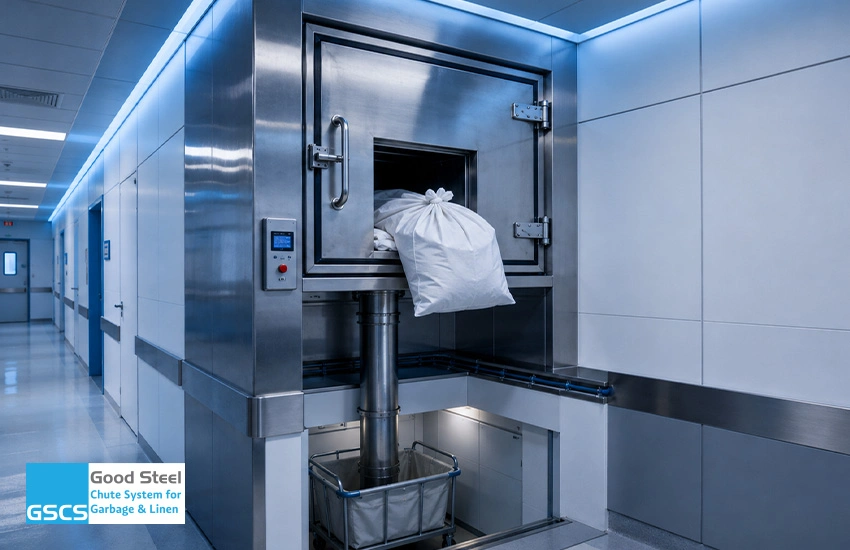
Hospitals move volumes of used sheets, towels, gowns, and other linen every day. When this work depends on carts and repeated trips between floors, staff spend more time moving loads through service areas.
The role of laundry chutes in hospital hygiene and efficiency is to create a controlled route for bagged soiled linen while supporting a cleaner, more organised daily workflow.
The Role of Laundry Chutes in Hospital Hygiene and Efficiency
A well-planned laundry chute allows bagged used linen to move from floors to a defined collection area. This reduces unnecessary handling between levels and gives housekeeping teams a clear transport path.
It can also reduce the number of loaded carts moving through corridors and service lifts, which matters in hospitals where staff, patients, supplies, and cleaning teams share space.
Plan your hospital linen system around the real daily workflow.
Read more about: Linen Chute System
How Laundry Chutes Support Better Linen Handling?
When planned correctly, linen chutes in hospital buildings can support:
- Faster transfer of bagged linen from upper floors.
- Fewer manual trips between wards and collection areas.
- A defined route for soiled linen.
- Better use of housekeeping time.
- Easier planning around service lifts and back-of-house spaces.
These benefits depend on the chute being sized and located for the actual volume of linen, not simply added to the building as a standard feature.
Read more about: A Guide for Fire-Rated Standards for Garbage & Linen Chutes
Key Hygiene Requirements for Hospital Laundry Chutes
A safe laundry chute system depends on these points:
- Bagging: Used linen should be contained at the point of use before transport.
- Separation: Clean and soiled linen routes should remain separate.
- Cleaning: The chute and collection area need practical access for routine cleaning.
- Operation: Staff procedures still matter. A chute supports the process, but it does not replace infection-control rules or safe linen handling.
Ask GSCS about a linen chute designed for healthcare use.
What a Hospital Laundry Chute System Should Consider?
A hospital chute should be planned around linen volume, floor count, intake locations, collection space, cleaning access, and fire protection. The route should fit housekeeping procedures and avoid movement through patient areas.
Capacity matters: an undersized system can slow handling, while poor access can make cleaning and maintenance harder.
Why One Standard Design Does Not Fit Every Hospital?
Hospitals differ in bed count, departments, height, service routes, and laundry workflow. A small hospital may need a different layout from a medical complex.
That is why chute diameter, door locations, discharge points, ventilation, controls, and maintenance access should be selected for the project rather than copied from another site.
Get a chute system specified for your hospital.
Where Efficiency Is Gained in Daily Operations?
The main gains come from reducing repeated transport tasks. A direct route for bagged linen can cut unnecessary trips between floors, free service lifts, and make collection more predictable for housekeeping teams.
Good access also helps maintenance teams inspect and service the system without causing disruption.
Choosing the Right Laundry Chute Partner
The supplier should understand the equipment and how the hospital will use it.
GSCS reviews project requirements, designs and manufactures chute systems locally, handles installation and commissioning, and provides maintenance through its technical team.
FAQS
You may also be wondering about these points before specifying or operating a hospital laundry chute:
1. Can infectious or contaminated linen be placed in a hospital laundry chute?
Yes, but it should first be sealed in suitable, clearly identified and leak-resistant bags according to the hospital’s infection-control policy.
2. Should laundry bags be closed before they enter the chute?
Yes. CDC guidance states that laundry bags should be closed before being placed in the chute, and loose items should not be dropped into it.
3. Can waste and used linen use the same chute?
They should normally use separate dedicated routes or chutes so waste and soiled linen remain separate and each stream can be handled according to its own safety and hygiene requirements.
A laundry chute works best when planned as part of the hospital workflow, not treated as a late construction item.
Discuss your hospital requirements with GSCS.