
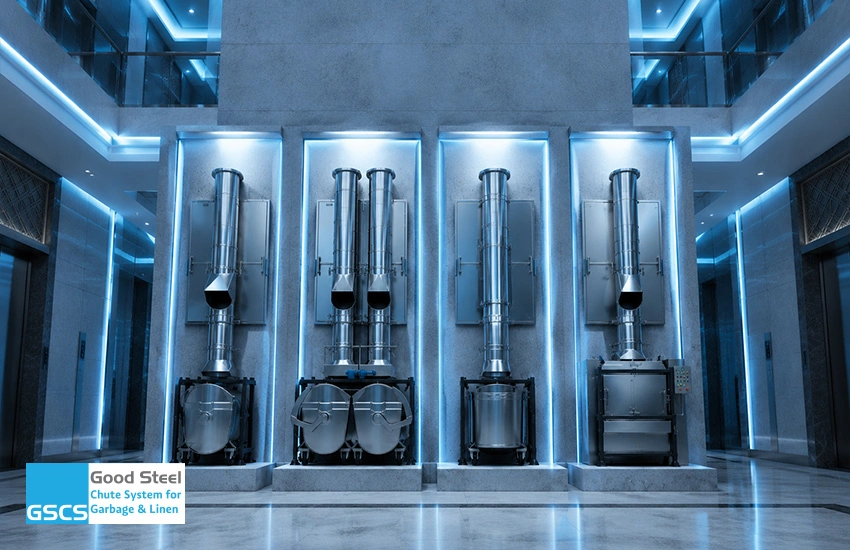
Managing internal waste within modern developments is a complex operational challenge. The United Nations Environment Programme (UNEP) expects global municipal solid waste to grow from 2.1 billion tonnes in 2023 to 3.8 billion tonnes by 2050. Consequently, developers and facility management teams must prioritise efficient internal waste logistics.
Understanding the primary types of garbage chutes available helps residential towers, compounds, hotels, hospitals, factories, and retail malls choose a system tailored to their daily operational demands, rather than just their physical height.
Main Types Of Garbage Chutes
A chute system should be selected based on waste volume, user behavior, cleaning requirements, the overarching facilities management strategy.
Standard garbage chutes
This is the common option in residential buildings and high-rise towers. Residents dispose of daily waste through intake doors on each floor, and the waste moves by gravity to a lower collection room.
It reduces bags in corridors, keeps elevators cleaner, and makes collection easier for facility teams.
Read more about: garbage chute system
Recycling garbage chutes
Recycling chutes are used when a building needs strict separation of waste streams. They are useful in projects that want to support greener building operations and reduce mixed waste.
Hospitals, modern compounds, offices, and mixed-use projects may need this type when eco-certification or waste sorting is integrated into daily operations.
Bi-sorter and tri-sorter systems
These systems allow users to choose where the waste goes before disposal. For example, one path can be for general waste and another for recyclables. A tri-sorter can support more waste categories.
This empowers buildings to manage waste segregation at the source, rather than paying for manual sorting later in the collection room.
Smart and sanitised garbage chutes
Some projects need more control over hygiene and operation. Smart chute systems can include control panels, ventilation, automated sanitising units, roof exhaust fans, and fire-rated doors. For busy commercial or premium residential buildings, this reduces odor problems, supports safer operation, and allows maintenance teams to monitor usage data remotely.
How to Choose Between Types of Garbage Chutes?
The best system is the one that fits how the building works every day.
Residential buildings and compounds
Residential projects usually require standard garbage chutes, but the design changes from one project to another.
A luxury tower, a large compound, and a mid-rise building will share entirely different user numbers, collection room size, or maintenance schedule.
Hotels, hospitals, and commercial buildings
Hotels may require separate linen systems, while hospitals and commercial buildings often demand much stricter sorting, cleaning, and safety control.
shopping malls and factories may need a custom setup depending on waste type, service routes, and daily traffic.
Speak to GSCS before choosing your chute system.
Why Does Custom Design Matter?
Looking at the types of garbage chutes is only the first step. The true value comes from designing the right system for the project.
GSCS designs, manufactures, installs, and maintains premium chute systems locally, backed by an expert engineering team specialised in garbage and linen chute solutions. This ensures that your system is planned flawlessly around the building’s infrastructure, tested thoroughly to international standards, and serviced by dedicated technicians who understand its exact design specifications.
Choose GSCS to design the chute system that fits your project.